
The cheapest advertised entry price is not necessarily the cheapest usable trip. Estimate total GB, full validity, fees, minimum top-up and country coverage before concluding a small bundle is good value.
Small allowances make sense for specific trips
A one-day stopover using maps and messages can justify a small prepaid data package. A week of video calls, mobile hotspot and photo backup is a different requirement. Use a data estimate from your real activities rather than purchasing by sticker price alone.
The second purchase is part of the decision
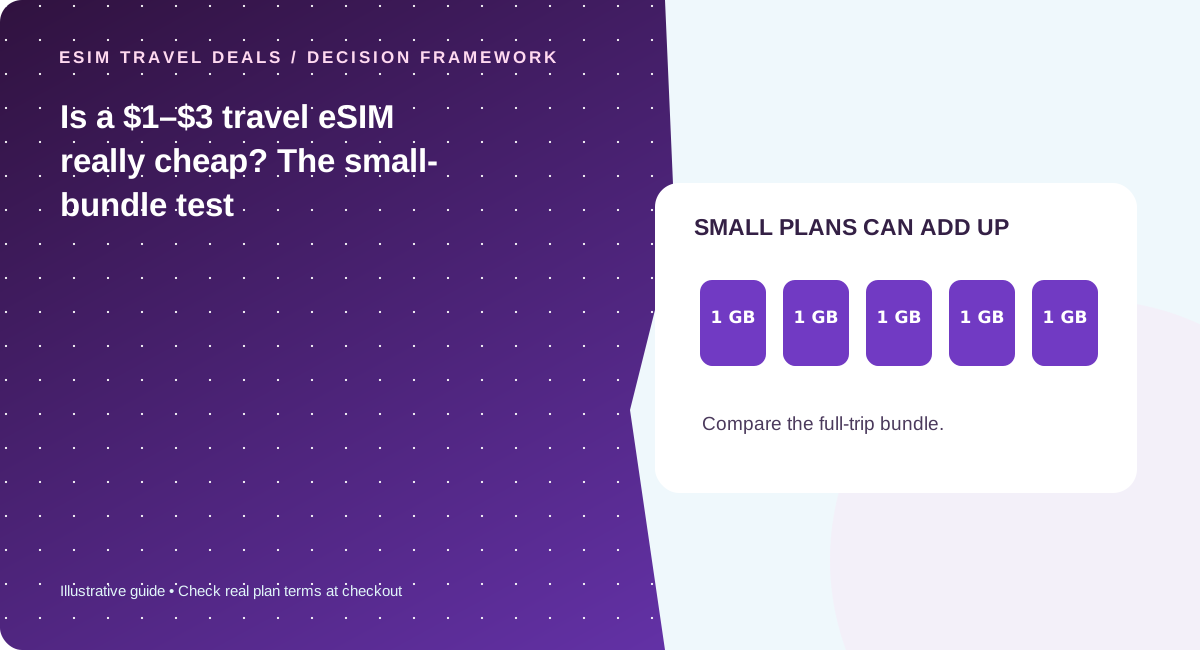
Suppose a plan costs $2 for 1 GB and you anticipate 5 GB. A purchase strategy involving five separate 1 GB packages has a hypothetical $10 total before any fees; whether it is possible or sensible depends on the provider’s rules. A larger plan might have better effective price per GB but be unnecessarily expensive if you use only 400 MB.
Check expiry and top-up rules
A cheap bundle can expire before a three-week vacation ends, even when some data remains unused. Check whether the plan supports adding data, whether topping up extends validity, and whether a new QR profile is required. A new profile at the wrong time may add operational friction.
Look beyond headline price
Payment processing, tax, device compatibility, speed restrictions, hotspot policy and support access matter. Retail promotions can be limited by location, promo-code eligibility, first-purchase status or payment method. Only claim a deal after the actual checkout confirms it.
A micro-bundle versus a realistic usage week
Imagine a three-day city stop where you expect to use messaging, search and short map sessions; a tiny bundle might be perfectly sensible if the phone is compatible and validity rules fit. Now imagine seven days with daily video meetings and photo backup. A low sticker price per 1 GB could become expensive when you need several top-ups. To compare, estimate the total GB first, then model the full basket price for the small packages. If you expect 5 GB and each 1 GB purchase costs a hypothetical $2, five identical packages cost $10 before taxes or reinstallation effort. This does not prove that a five-GB product for a certain price exists. It demonstrates that the correct denominator is usable data over the required days—not the smallest advertised checkout.
Hidden friction to count without exaggerating
A second purchase may require separate QR installation, payment, reactivation, or a device switch, depending on the vendor. Some bundles expire long before the trip ends. Promotions may be first-order only, and some advertised discount codes do not work for the destination you selected. Record the plan’s top-up support, initial expiry, full-speed entitlement and whether hotspot is included. Remember that a plan’s theoretical cost per GB is not a meaningful saving if most of the bundle will go unused. Conversely, a large cheap bundle can be unsuitable if it expires before the last travel day. Honest price guidance should explain the likely purchase sequence, not just sort dozens of product cards by their smallest price tag.
Five checks before you pay
- Estimate your data use before shopping
- Compare total cost for the required GB
- Check expiry and start rules
- Confirm top-up and hotspot terms
- Use actual checkout, not banner prices
Common mistakes to avoid
- Price per GB is misleading when you will not consume the bundle
- Multiple small plans may require multiple activations
- A discount banner may not apply at checkout
Work with your real itinerary or quotes
Use our free in-browser calculator, then verify live plan stock, exact destination coverage and final charges directly with TripoSIM.
Commercial disclosure: we are owned by BroadNet and promote TripoSIM. No specific retail SKU or guaranteed price is represented here.
Source notes and review standard
This page is educational editorial analysis dated 5 November 2026. It does not claim field measurements, current retailer inventory, exclusive third-party quotes or verified network speeds. Confirm the exact product terms and local phone configuration before paying.
Additional context: our research methodology and editorial standards.
Continue reading
Four countries in 12 days: regional eSIM versus local passes
A cost model for an itinerary with overlapping national prices, changes of plan and border downtime.
Travel eSIM refund rules: what to check before you pay
Reduce refund surprises by checking activation status, device compatibility and the actual merchant policy.