
Compare one eligible regional plan with all local-plan purchases including unused allowances, setup effort and cross-border downtime. The lowest total price only wins if every country and the required duration are genuinely covered.
Build the 12-day country schedule
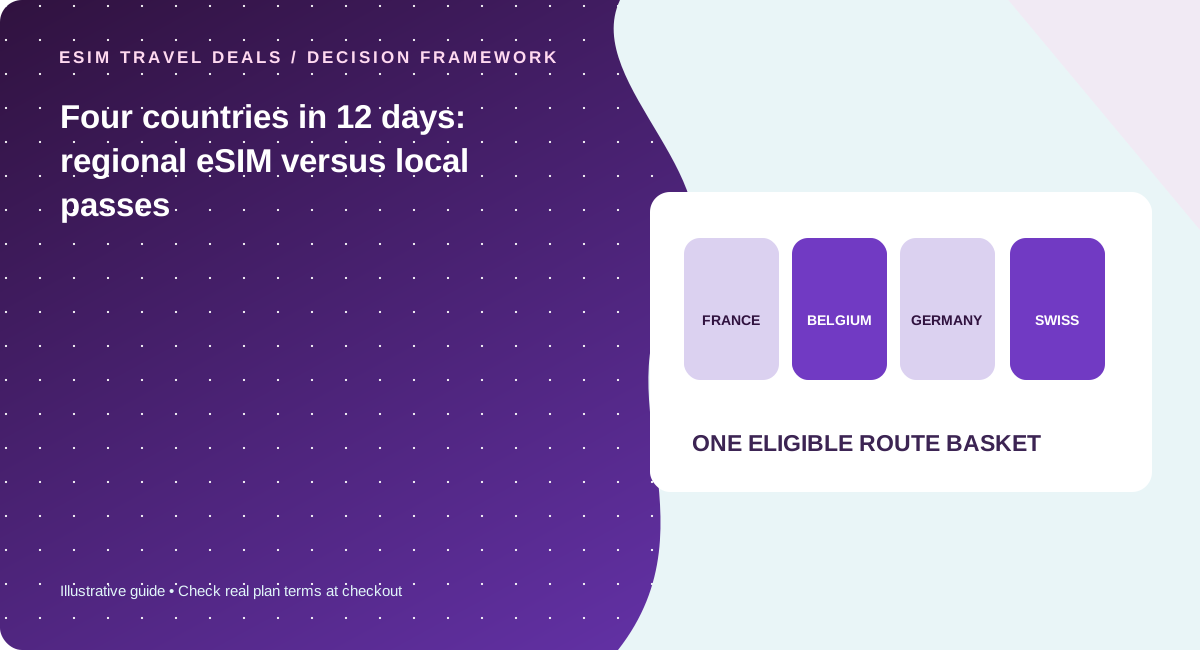
For example, allocate four days to France, three to Belgium, three to Germany and two to Switzerland. Your required data varies by day, but the coverage condition is binary: every border must appear in the plan’s actual supported country list. Switzerland is the stop most likely to invalidate a simplistic “EU-only” assumption.
Calculate regional and local baskets
A regional plan has one price and one validity window. A local basket needs prices for every stop, potentially four tax and payment events, possible unused GB and any separately purchased top-ups. Keep the comparison on the same currency and comparable data amount. Do not invent live catalog results where no authenticated feed exists.
Include time and failure risk
Multiple installations can be manageable, but they add opportunities to select the wrong data SIM or arrive without a usable QR code. For a rail itinerary, a small price difference may not justify a connection interruption during a transfer. For a long stay in one country, local pricing may eventually become attractive.
Check the home tariff first
EU resident travelers can benefit from regulated roaming under eligibility and fair-use conditions, potentially lowering the incremental benefit of a travel eSIM. The exact contract and home market determine the comparison. Neither travel eSIMs nor local prepaid SIMs should be assumed cheaper by default.
A comparison template for France, Belgium, Germany and Switzerland
Use four rows for the four destination countries, and annotate dates, required data and whether a candidate regional SKU includes each one. The inclusion of Switzerland cannot be inferred from an EU country label. Build two purchase baskets: one valid regional SKU, and separate local SKUs for each stop, using only final verified merchant prices. The separate basket may buy more total GB than you will use; avoid treating those extra gigabytes as value unless they are useful. Add payment fees, possible top-ups and the time required to switch eSIM profiles during a busy train connection. The best result is a comparison of two *eligible* strategies, not a rank ordering of irrelevant low-priced plans. If your existing EU subscription has an applicable regulated roaming entitlement, compare that as a third basket.
How to price reliability when all options look cheap
Suppose you are connecting to a client call at a rail station shortly after crossing a border. The cost of switching profiles at that moment may exceed a small numerical price difference, even though it does not appear as a fee. For a long stay in one country and short visits elsewhere, local service plus a regional backup might be sensible. Conversely, one regional plan can simplify the experience for rapid multi-stop tourism. Before paying, confirm the validity clock, whether a top-up restarts or extends the period, and any hotspot-specific restrictions. On-device data selection should be clear so the home carrier does not unexpectedly carry international traffic. The worksheet is useful precisely because it makes non-price costs visible without inventing live carrier statistics.
Five checks before you pay
- List each destination and number of days
- Compare eligible coverage in all four countries
- Calculate all local-purchase checkout totals
- Account for unused GB and reactivation effort
- Compare against the home carrier’s actual roaming entitlement
Common mistakes to avoid
- An EU regional label may not guarantee Switzerland
- Unused allowances may not transfer between separate local profiles
- Regulated EU roaming benefits depend on the original subscription
Work with your real itinerary or quotes
Use our free in-browser calculator, then verify live plan stock, exact destination coverage and final charges directly with TripoSIM.
Commercial disclosure: we are owned by BroadNet and promote TripoSIM. No specific retail SKU or guaranteed price is represented here.
Source notes and review standard
This page is educational editorial analysis dated 5 November 2026. It does not claim field measurements, current retailer inventory, exclusive third-party quotes or verified network speeds. Confirm the exact product terms and local phone configuration before paying.
Additional context: our research methodology and editorial standards.
Continue reading
Travel eSIM refund rules: what to check before you pay
Reduce refund surprises by checking activation status, device compatibility and the actual merchant policy.
Study abroad: the true mobile-data cost of a semester
Model arrival connectivity, monthly renewal, video classes and local number needs in one realistic budget.