
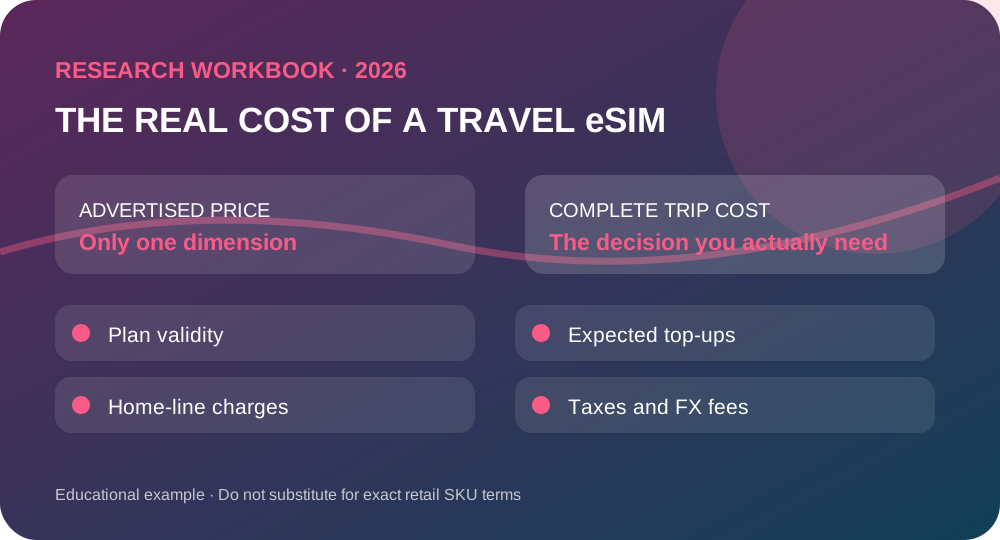
A cheap gigabyte is not always a cheap trip.
A headline price answers only one question: the lowest displayed entry cost. Buyers need a complete basket that includes validity, usable data, top-ups, fees, the original line, and the risk of buying an unsuitable plan.
The five numbers that actually determine value
The most useful comparison begins with five observations: the number of days during which the plan must work; total usable high-speed data; the final payable price in the customer’s currency; any expected top-up or repurchase; and the cost of preserving the home number for calls or security codes. These dimensions should be recorded beside each competing option, not scattered across multiple browser tabs.
A carrier might advertise a roaming day pass with a daily charge. Calculate the number of chargeable days under the operator’s exact billing rules; a brief network attachment can count as a full day depending on the terms. By contrast, an eSIM may have a single validity window and a fixed allowance. Neither structure is intrinsically cheaper. The deciding variable is your real trip pattern.
Example: if a hypothetical roaming pass costs $12 for each of eight chargeable days, its arithmetic cost is $96. A hypothetical 10 GB travel eSIM offered at a final $29 seems better, but only if the trip fits its validity, 10 GB is sufficient, and any original-number charges are understood. These are illustrations, not TripoSIM or competitor quotes.
Why price per GB can lead to the wrong purchase
Price per GB is useful only when comparing plans with similar validity and conditions. A 20 GB plan that expires before your return flight does not supply 20 usable GB for the trip. A 1 GB bargain may look attractive until a second or third purchase adds payment fees or installation complications.
Our archived country-level TripoSIM dataset covers 198 destination records. In the snapshot, the median listed 1 GB price across 196 records is $3.33; the median 5 GB figure across 197 records is $11.99, and the 10 GB median across 196 records is $20.43. These medians are descriptive of supplier observations, not equivalent plan-level quotes: durations, country coverage and activation rules are not normalized.
Never add several country-tier snapshot prices and call the result a valid regional plan. A data catalog may show that country-level packages exist without demonstrating that one retail SKU spans all countries or lasts the correct number of days. Use the figures to inform questions, then verify the offer that can actually be bought.
Discount verification: test the checkout, not the badge
An advertised percentage discount is meaningful only if the comparison price is genuine and the terms match. Ask whether the original price was routinely charged, whether the deal is available to your account, and whether the coupon applies to the specific destination and data tier. Do not assume a banner applies to the product you are about to pay for.
Capture the final checkout subtotal, taxes if applicable, service fees, exchange-rate effects and currency conversion. When purchasing in a different currency, an issuing bank or payment processor may change the effective total. Document the amount actually charged rather than relying on a screenshot of a marketing card.
A sound comparison should also distinguish “lowest entry price” from “lowest adequate trip price.” Two offers with different GB amounts or activation policies are not interchangeable. When a seller has no dated evidence for a promotion, it is safer to avoid making a “best deal today” claim than to mislead a buyer.
A complete break-even workbook for a mixed-use trip
Consider a nine-day trip with four active sightseeing days, three workdays, and two transit days. Suppose the traveler can use hotel Wi-Fi on workdays but needs reliable mobile maps on transit days. The home carrier’s roaming pass charges a hypothetical $10 per chargeable day. If the phone attaches abroad on all nine days, the apparent total is $90. If only seven days are chargeable under the exact terms, it is $70.
Now compare a hypothetical $24 plan with 8 GB and nine days of confirmed validity. Add any expected top-up, payment fees and the cost of home-line voice/SMS. If an extra 5 GB top-up costs $14, the projected total becomes $38 before home-line costs. If the plan excludes a destination or expires a day early, it is not an eligible comparator, regardless of the price.
The break-even test is not just “$24 versus $90.” It is whether the eligible eSIM basket is cheaper than the eligible home-carrier basket after expected usage and risk adjustments. Visitors can use the on-site calculator with their own real carrier and checkout prices rather than treating these numbers as live offers.

Families and groups: the cheapest individual plan may not win
For three travelers, compare separate eSIMs against one hotspot-capable plan only after checking the hotspot rule, battery resilience and each person’s autonomy. If one phone carries the shared connection, it becomes a single point of failure. Children needing transport tickets or separate itineraries may justify their own connectivity even where the arithmetic favors one large plan.
Corporate travelers should include invoice requirements, local taxes, reconciliation rules and support availability. A low-cost plan without the correct billing evidence can create administrative work that exceeds the headline saving. Conversely, buying surplus data for every traveler wastes money when real use is low.
Pre-purchasing before travel can reduce airport stress, but start-of-validity rules matter. The cheapest pack purchased far in advance might expire too early if installation triggers the clock. Build that check into the actual purchase decision.
An honest research comparison: what the data can and cannot say
The local historical dataset is supplied in CSV/JSON form with country names, observed 1/5/10 GB prices, some network indicators and unlimited-policy observations. It is useful for transparent descriptive studies and trend questions but does not provide an independently verified, real-time 240-provider comparison. We disclose that the site belongs to the TripoSIM commercial ecosystem.
Our three editorial domains are not independent review agencies. We should not fabricate customer ratings, “verified discounts,” provider rankings or winner badges. A valid research claim must identify a source, observation date, method and limitation. Updated listings should replace out-of-date claims rather than silently preserving a price that is no longer offered.
Where a comparison outcome depends on a live plan’s exact validity, data cap or final checkout price, the only defensible result is “verify at checkout” until the authenticated retail feed has been connected and reconciled against merchant data.
Buying checklist for the final minute
Open the actual plan and check destination coverage, allowance, activation trigger, expiration, tethering, speed/fair-use restrictions and full amount. Confirm the phone is compatible and that support instructions are accessible when offline. For price-sensitive travelers, a strong choice is an eligible plan with the lowest complete expected trip cost—not necessarily the cheapest banner.
Our purchase links open TripoSIM, which is commercially affiliated with this editorial website. The independent value here is the calculation method and transparent caveats; no claim is made that every supplier on the market has been compared.
Make the decision with your actual trip details
Use the esimtraveldeals decision tools
The seller’s current SKU terms always determine eligibility and the final payable price.
Open the decision lab →Compare your trip requirements →Check TripoSIM plans ↗Sources and editorial limits
Official references used for general legal, platform, or technical context:
- European Commission: EU roaming terms
- EU Your Europe: roaming charges and ship/plane caveats
- Google Search Central: people-first content standards
- European Commission: consumer price sweep
Country-level TripoSIM figures are an archived supplier snapshot covering 198 destinations. They are not current checkout offers, independent carrier measurements, or guarantees of plan-specific validity, networks, or performance. This website is commercially affiliated with TripoSIM. Updated retail eligibility and final price must be checked on the seller’s current offer.
Turn this research into a buying checklist
Use the eligibility calculator to organize your requirements before opening TripoSIM. Check exact coverage, price and validity at the merchant.
Calculate your next step →Commercial affiliation: this website and TripoSIM are part of the same business network.